Why a roof in the Miami Valley ages differently than one in Atlanta — and what property owners can do about it.
If you’ve ever heard a friend in a warmer state mention their 30-year-old roof is “still going strong,” you might have wondered why your own roof seems to need attention every decade. The answer is simple: weather. And here in southwestern Ohio, the weather is doing more to your roof than you probably realize.
Property owners across the Miami Valley — whether you’re managing a commercial building in downtown Dayton, a warehouse in Kettering, or a home in Beavercreek, Centerville, or Springboro — are working with a roofing system under more stress than almost anywhere else in the country. Here’s what’s happening up there, and what it means for how you maintain and plan for your roof.
The Freeze-Thaw Cycle: The Silent Roof Killer
Ohio winters don’t behave. A typical January in Dayton will see temperatures swing from single digits at night to well above freezing during the day — sometimes within the same 24 hours. That cycle, repeated dozens of times each winter, is one of the hardest things a roof can endure.
Here’s what’s happening on your roof: snow melts during the day, water seeps into tiny cracks, gaps, and seams, then freezes again overnight. Frozen water expands by about 9%. That expansion forces those small gaps wider, every single time. After a few hundred cycles — which is a normal Ohio Valley winter — small problems become big ones.
This is why the same shingles rated for 30 years in a stable climate might give you 22–25 years here. The material isn’t worse — the conditions are.
Ice Dams: The Problem That Hides in Your Attic
If you’ve ever seen those impressive icicles hanging from the edge of a roof, you’re looking at a warning sign. They’re often the visible part of an ice dam — a ridge of ice that forms at the edge of a roof and prevents melting snow from draining off properly.
Ice dams form when heat escapes from the attic, melts the snow on the upper portion of the roof, and that water refreezes when it reaches the colder eaves. Once the dam forms, water backs up behind it — and starts seeping under the shingles. From there it gets into the decking, the insulation, and eventually the walls and ceilings inside.
The damage from a single bad ice dam season can run into tens of thousands of dollars on a commercial building, and is one of the most common drivers of premature roof replacement in our region. The fixes — better attic insulation, balanced ventilation, ice-and-water shield underlayment at the eaves — are all addressable, but only if you know to ask for them.
Wind, Hail, and Ohio’s Severe Storm Season
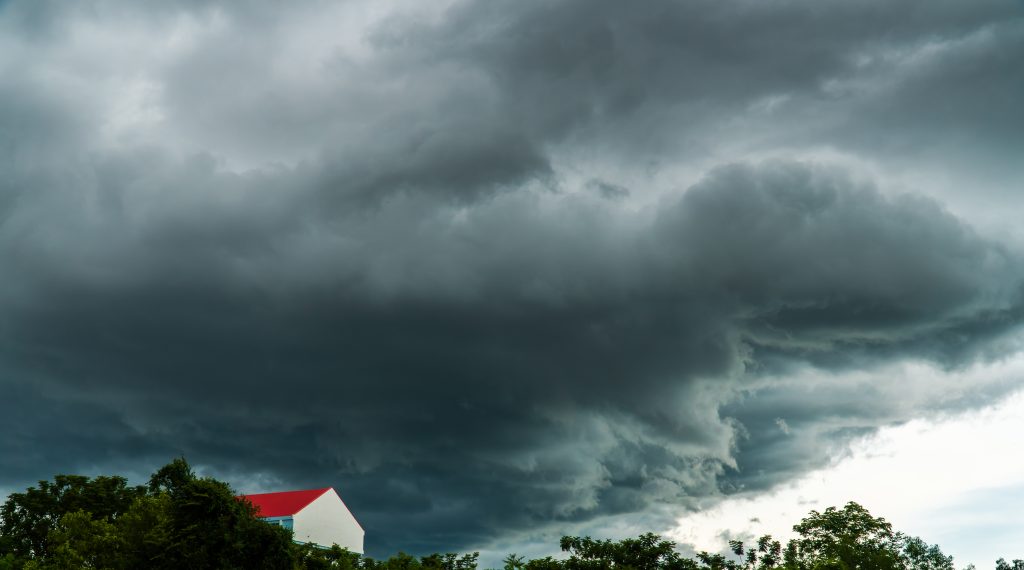
Ohio summers bring their own challenges. The collision of warm Gulf air and cooler northern systems makes the Miami Valley one of the most active areas in the country for severe thunderstorms. Dayton sits squarely in a region that sees regular hail events and damaging straight-line winds. That means three things your roof has to deal with on a regular basis:
- Straight-line winds. Sustained winds of 60+ mph can lift and tear shingles, especially older ones that have lost flexibility.
- Hail. Even small hail bruises asphalt shingles — the damage often isn’t visible from the ground but accelerates granule loss and shortens lifespan.
- Heavy rain. Intense downpours can overwhelm gutters and find their way under flashing or in valleys.
After any major storm, it’s worth scheduling a professional inspection — even if everything looks fine from the driveway. Hail damage in particular is often invisible to the untrained eye but well-documented to insurance adjusters, and most policies have time limits for filing claims. (Insurance claim navigation is one of the things we help our clients with most.)
Humidity and the Hidden Cost of Summer
People forget about the summer side of the equation, but Ohio Valley humidity is brutal on roofing systems. Hot, humid air rises into your attic, where it cools and condenses against the underside of the roof decking. Without proper ventilation, that moisture sits there — day after day — and slowly rots the wood from the inside.
Owners often discover this only when a roofer pulls up old shingles and finds soft, dark, spongy decking underneath. The shingles weren’t the problem; they were just the lid on a much bigger issue. Proper attic ventilation — ridge vents, soffit vents, and balanced airflow — isn’t optional in this climate. It’s the difference between a roof that lasts its full lifespan and one that quietly fails a decade early.
What Property Owners Can Actually Do About It
You can’t change the weather, but you can absolutely change how well your roof handles it. Here’s what makes the biggest difference in this region:
- Spec for the climate, not the average. Use ice-and-water shield underlayment in the eaves and valleys. Choose impact-rated shingles or metal in our hail-prone storm corridor. The upgrades pay for themselves.
- Get serious about attic ventilation. Balanced intake (soffit) and exhaust (ridge) ventilation extends roof life by years.
- Inspect twice a year. Spring and fall inspections catch small issues before winter or storm season turns them expensive.
- Document storm damage immediately. Photos and a professional inspection within days of a storm protect you in any insurance claim.
- Keep gutters clear. Clogged gutters are the leading preventable cause of fascia rot and ice dam formation.
Local Expertise Matters More Than You’d Think
A roofer who’s been working in the Miami Valley for years knows things a national chain or a transplant contractor won’t — which products hold up to our specific freeze-thaw cycles, what insurance adjusters in this region look for after hailstorms, where ice dams typically form on the building styles common around Dayton, and how to spec ventilation for our humidity profile.
Ram Roofing has worked exclusively in the Miami Valley and greater Dayton area since 2012. We’re family-owned, locally-owned, and we’ve seen what these winters and summers do to roofs — so we build for it. Whether you’re maintaining a commercial property, planning a replacement, or just want a professional opinion after a rough storm, we’d love to take a look.
Book your free inspection: Call 937-882-5600 or schedule online at ramroofingusa.com/book-an-appointment/Everything under one roof.
https://shorturl.fm/BGyiY
https://shorturl.fm/M0hEd
https://shorturl.fm/mH2Rr
https://shorturl.fm/L9LX2
https://shorturl.fm/hDuhF
https://shorturl.fm/IHGGT
https://shorturl.fm/snkzC
https://shorturl.fm/xiO9U
https://shorturl.fm/wpKAD
https://shorturl.fm/3s7Ji
https://shorturl.fm/5z7UY